
Well, that was quite the week to take a vacation. It seemed like every stock in the Emerging Moats portfolio went up or down 20% while I was gone. Expect the same when I take another vacation six months from now. The market is getting increasingly manic, with any hint of being an AI “loser” crushing share prices, trying to distract you from focusing on what matters (fundamentals). The stock price will take care of itself. Volatility is the price of doing business when you run a concentrated portfolio that is uncorrelated with the indices…which is the point of buying individual stocks.
The largest winner for Emerging Moats has been Oscar Health. Up 104% since the end of March, the health insurance disruptor posted its earnings on May 6th, keeping its stock moving up and to the right in a trance-like line. Whatever Wall Street and the short-term pod shops were looking for, Oscar Health delivered.
Here is what I wrote on Oscar back in late 2025:
“My thesis is simple: 2025 is a temporary blip for Oscar Health’s MLR. Over the next decade, it has a clear path to MLR stability, improved operating leverage, and market share gains, which should provide the stock with upside in 2026 and the potential for ten-bagger returns over the next decade.”
The company is beginning to show us that it is executing on this thesis (scale, operating leverage) at a much faster pace than I assumed. Fears about the destruction of the health insurance market have proven overblown, providing management the opportunity to shift from defense to offense. The growth runway in the individual payor market is massive. Oscar Health remains the clear candidate to steal share.
A classic Peter Lynch stock.
In this update, I will cover:
Why the stock finally got unstuck
Remaining growth tailwinds
Is there still an emerging moat?
My investment decision
Portfolio Update + addendum on Gambling.com Group
Why the stock finally got unstuck
Q1 headline numbers were fantastic for Oscar Health.
Revenue grew 53% to $4.6 billion, with guidance reaffirmed for the full year at $18.7 billion to $19 billion. More premium revenue gives Oscar Health the scale needed to operate profitability nationwide. Scale gives it the ability to offer “product parity” across healthcare services compared to legacy institutions, which Oscar Health has lacked in its early years (check out this Reddit post for anecdotal evidence). Premiums have grown at a 50% CAGR since 2019, and should continue to grow at a double-digit rate for the foreseeable future.
Another way to look at the topline and scale is the total number of Oscar insurance members. Investors were uncertain how the expiration of extended ACA marketplace subsidies would impact demand in 2026 and balked at the initial guidance in the Q4 2025 earnings release. I mean, the stock got down close to a market cap of $3 billion when it was guiding for close to $300 million in operating earnings this year; there had to be significant doubts these targets would be hit.
Mr. Market was clearly in “show me” mode, and, well, Oscar Health delivered:
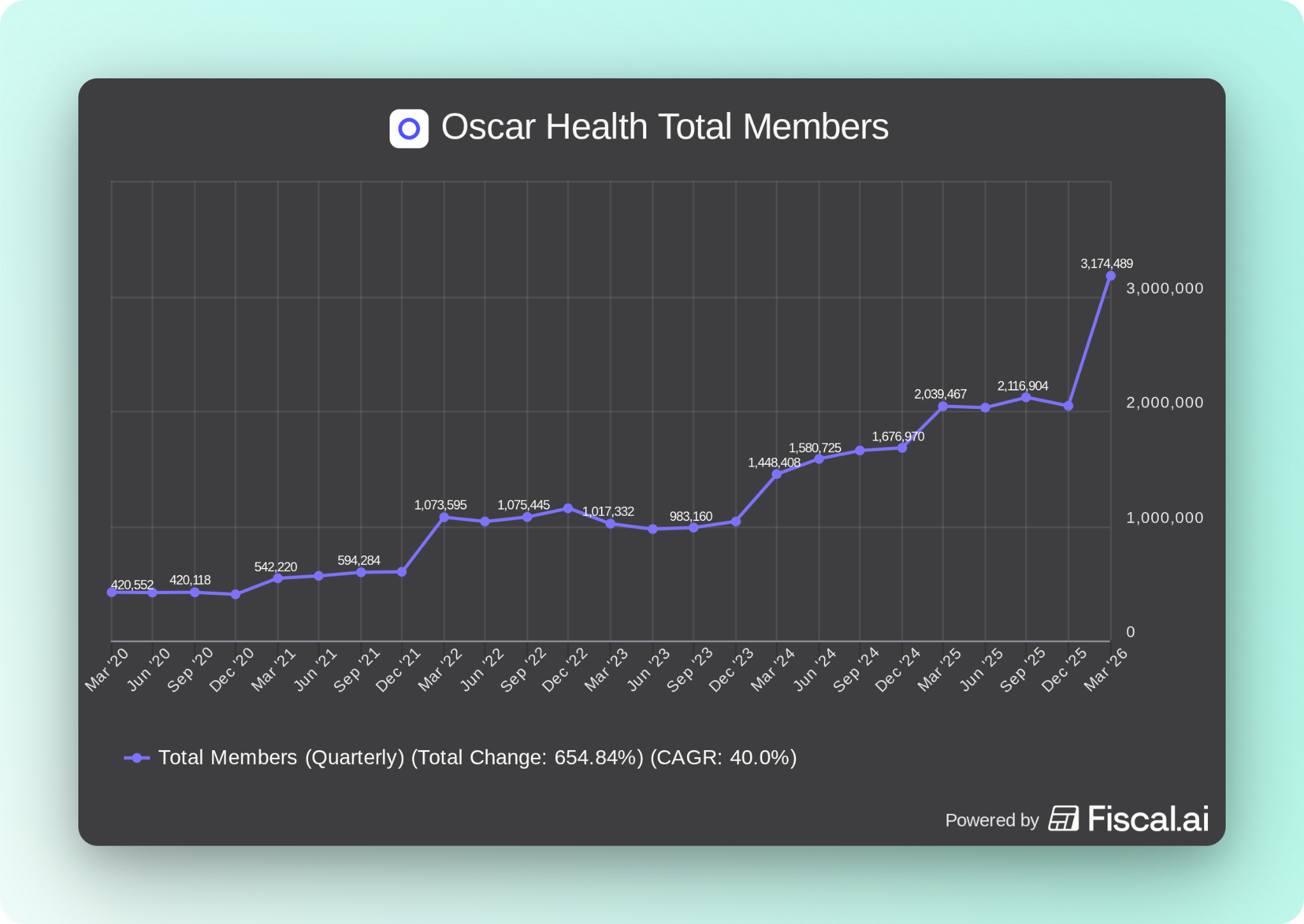
Oscar grew its members by around 50% to 3.2 million at the end of Q1 2026. Normally, given the annual nature of choosing a health insurance plan, total members remain relatively steady throughout the year. However, with significant price increases imposed on ACA health insurance providers in 2026 and expiring subsidies, Oscar Health has seen much more churn than in previous years. It began the year with 3.4 million members, which fell to 3.2 million at the end of Q1 and has since fallen to 3 million, according to management commentary on the conference call. This is something to keep track of throughout the year, but the current churn levels are in line with management’s topline guidance for 2026.
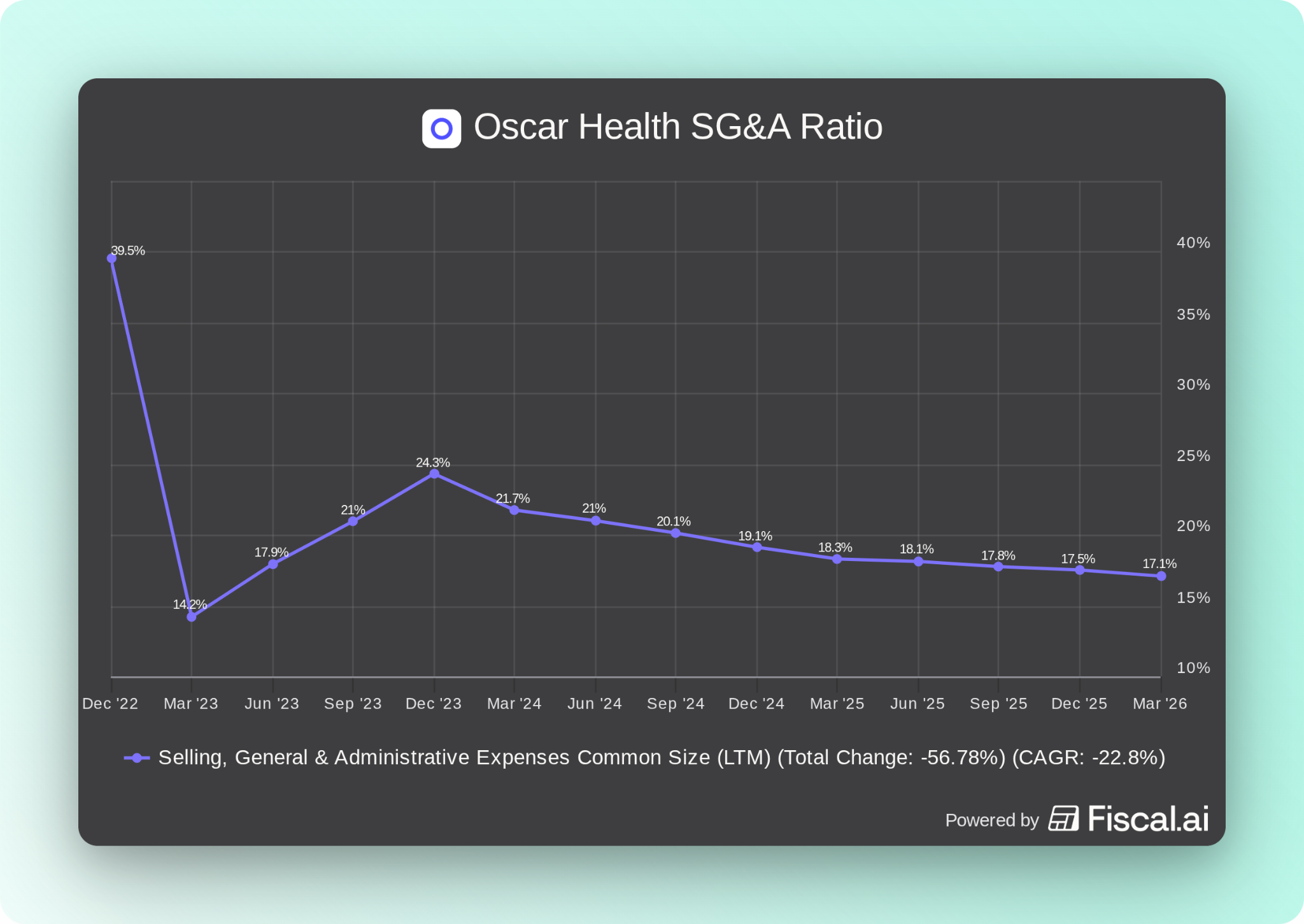
Oscar Health’s profitability comes from operating leverage over its fixed cost base, and it showed further progress in this quarter. The SG&A ratio fell to 15.2% compared to 15.8% the year prior. Remember that in the individual payor market, current regulations cap the medical loss ratio (MLR) at 80%, leaving a 20% gap for overhead costs. The lower the SG&A ratio (operating expenses as a % of revenue), the more room there is for operating margin expansion.
LTM SG&A ratio continues to fall, hitting 17.1%. The full-year outlook calls for around 16%, which would be quite impressive if achieved.
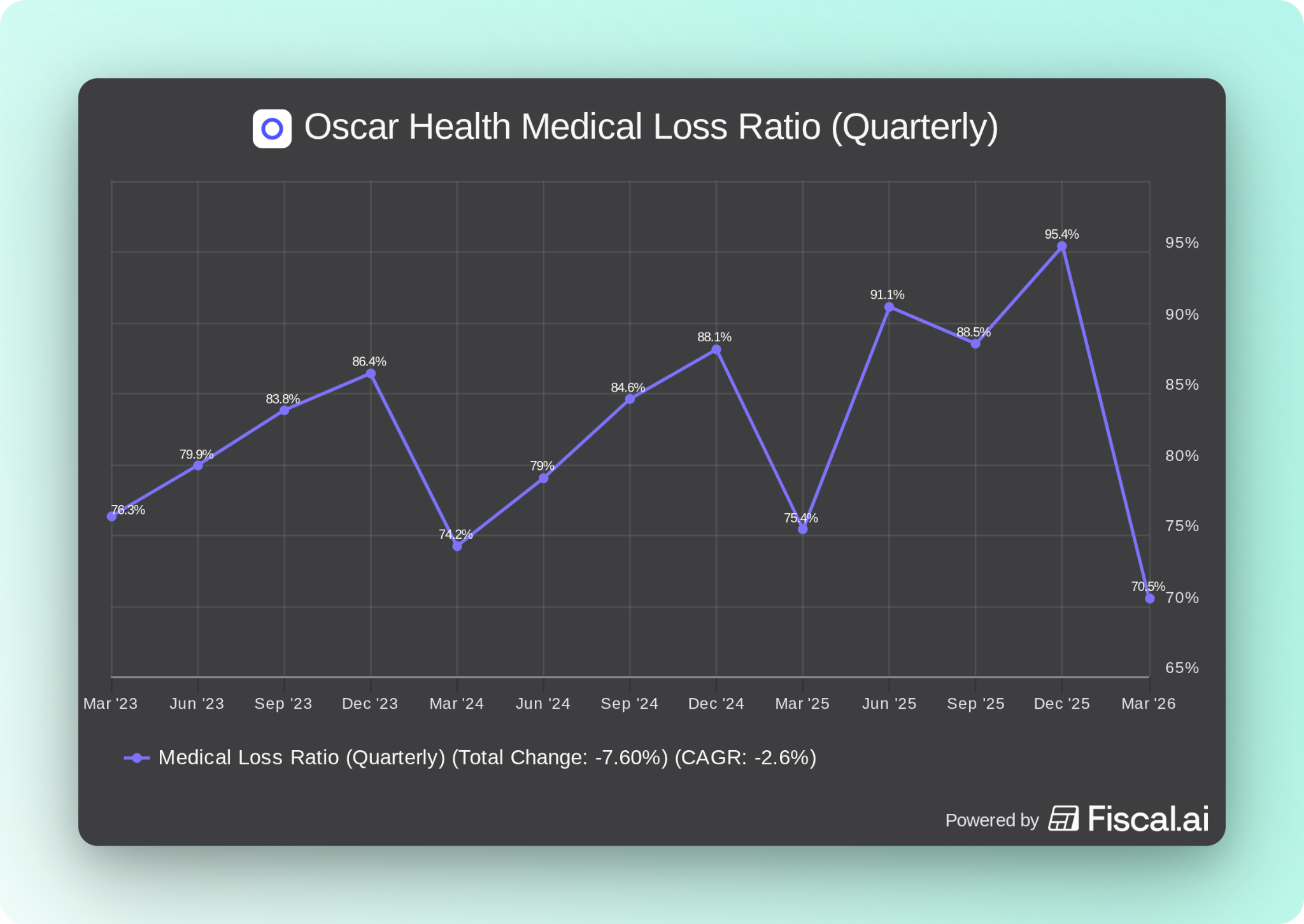
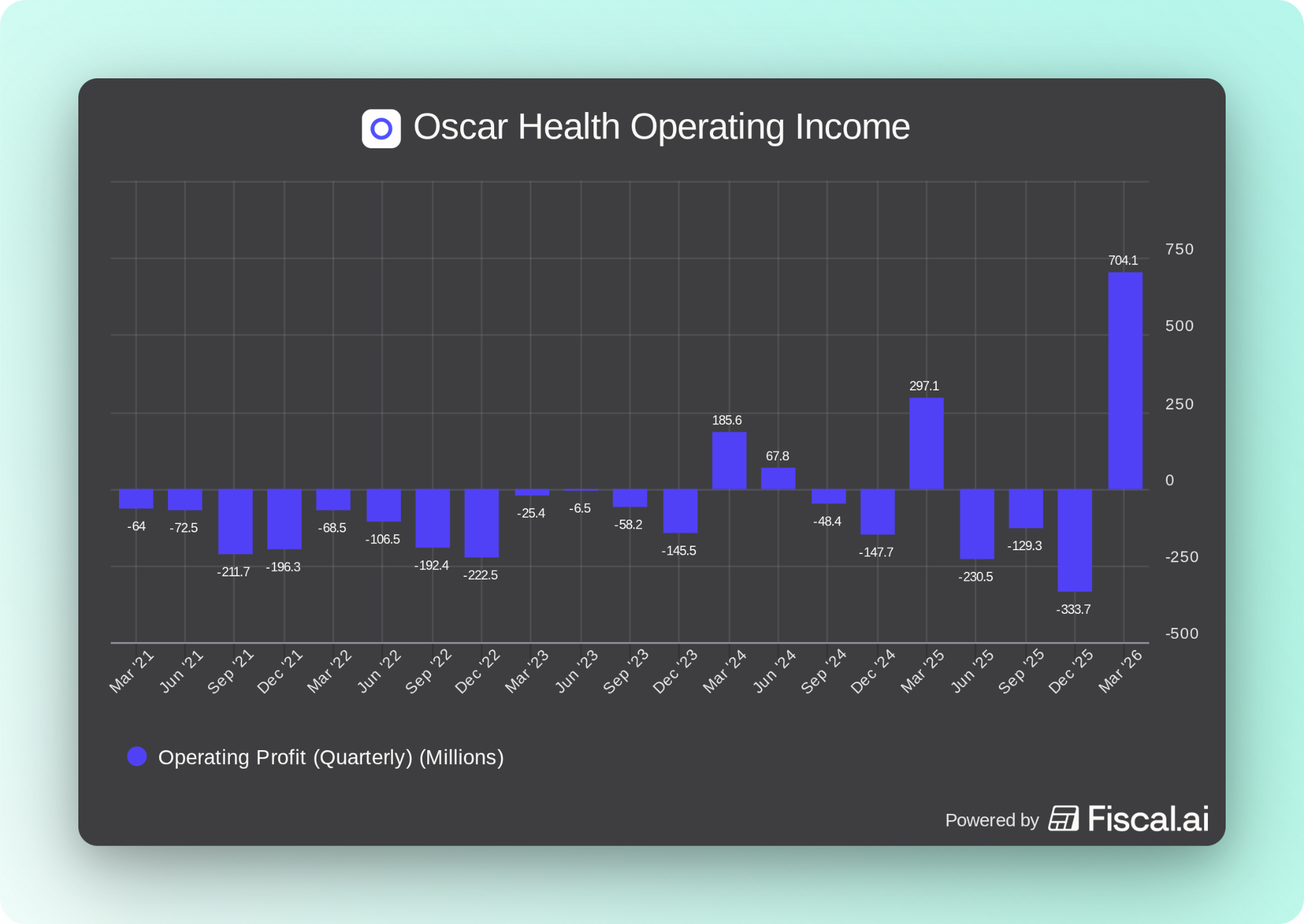
Oscar Health generated $704 million in operating income in Q1 with an MLR of 70.5%. With guidance of $250 million to $450 million in operating income for the full year, the company expects operating losses for the last nine months of 2026. This is entirely normal seasonality for an ACA insurance provider, as monthly premiums remain the same while healthcare utilization rises throughout the year. You can see this in both the operating income line and MLR each quarter.
Q1 MLR was significantly lower than in prior years, suggesting Oscar may finally be pricing its plans to more closely target the 80% ceiling (its best annual ratio ever was 82%). Management may be sandbagging guidance or staying conservative given the volatility in healthcare utilization in 2025, because if it hits close to an 80% MLR, achieves a 16% SG&A ratio, and $19 billion in premium revenue, that is $760 million in operating earnings this year.
Unless we see more headwinds in healthcare utilization through the summer months, expect Oscar Health to upgrade its guidance later this year.
Remaining growth tailwinds
Long-term, what will matter to Oscar Health is whether it can scale up its membership from ~3 million to tens of millions. If it does, there is the makings of a 100-bagger, especially from the lows at the end of March.
It remains a market share gainer in the individual payor market. This is evidenced by the 50% membership growth at the start of 2026, while the entire market contracted amid rising prices and subsidy expiration. Many of Oscar’s competitors are leaving the individual market, allowing it to thrive and take a leadership position in this niche.
However, there is still only a limited addressable audience among existing individual payors. According to KFF analysis, the number of individual payors may fall to 17.5 million in 2026, down from 22.5 million in 2025. That already gives Oscar Health significant market share.
Oscar will need to expand into the employer market and turn them into individual payors, which it is doing through Individual Coverage Health Reimbursement Arrangement (ICHRA) plans. These are plans in which employers give tax-free dollars to employees, who then use those funds to buy health insurance through the individual market, potentially choosing Oscar.
The problem is convincing employers that their employees can find adequate coverage in the individual market. In order to fix this, Oscar has launched Lucie, an online marketplace where employees can find the best plans for themselves, even if it isn’t Oscar:
“Lucie helps employers offer great benefits at lower costs. Employers define their budget and fund tax-free employee wallets. Lucie brings it all together in a single platform where teams can choose the products they value most. No more juggling multiple point solutions or dreading unpredictable annual rate hikes.”
Oscar can win with Lucie in two ways. First, it should help more employers switch to ICHRA plans, some of which will flow through to Oscar Health plans. Second, I assume it is getting some of the economics of health insurance purchases made through the Lucie marketplace, which should have nice margins.
This expands Oscar’s addressable market from 20 million members to 100 million or more, giving it the opportunity to gain further nationwide scale. It will take many years of convincing, but the snowball is beginning to form, with incentives from everyone except the incumbent insurers to make the change. Employers want simpler solutions at a lower cost. Employees want a wider choice of healthcare plans that actually serve them.
“Oscar recently brought the industry together to launch ICHRAx to meet the rising demand. ICHRAx will be a plug-and-play data exchange connecting carriers, benefit brokers, and ICHRA platforms to create a more consistent employee experience. States like Mississippi and Illinois are taking steps to incentivize ICHRA adoption by giving tax credits to businesses. Oscar is now working with other state legislatures and business groups to advance similar ICHRA policies that support local economies and reduce the friction of traditional employer coverage. Building on this momentum, we recently launched the Lucie Health Marketplace. Lucie is a carrier-agnostic shopping platform for consumers, brokers, and employers built on one of 11 CMS-approved systems. Lucie brings together a wide selection of ACA plans with leading ancillary and supplemental products like Aflac. We are combining our technology capabilities with individual networks in nearly every zip code nationwide.” - Q1 2026 Conference Call
I think it is smart for Oscar to try to bring the entire industry to ICHRA plans, even if not everyone chooses Oscar for their health insurance needs (it would be egotistical to think this small player is perfect for everyone today). In the long run, Oscar can win significant market share by leveraging its technology-first systems to win over customers.
With continued growth in healthcare spending driven by an aging population, Oscar Health’s revenue per member should increase as well.
I don’t know if it will be 2030, 2032, or 2035, but the path to $100 billion in premium revenue is well within reach. That is simply how large the opportunity in health insurance is, one I underappreciated when initially looking at this stock. A standard 5% net income margin (remember that health insurers also earn interest income on float) would equal $5 billion in net earnings on $100 billion in premium revenue.
The current market cap is $6.7 billion. There is still plenty of upside for Oscar stock if it keeps on its current trajectory.
Is there still an emerging moat?
There is not much new to add about Oscar’s emerging moat, except that it is making progress faster than I previously assumed. Premium revenue of $19 billion is nowhere near the size of UnitedHealth's, but we are already seeing the fruits of potential operating leverage, with a steadily falling SG&A ratio and a positive operating earnings guide for 2026. Any new entrant into the ACA marketplace would have to subsidize losses for a decade while operating with a subscale healthcare network for members.
The only way a competitor can build a better mousetrap is by matching or beating Oscar’s technology and digital products. Assuming none of the legacy players will catch up feels like a reasonable bet. A start-up may try to attack them, but it will likely fail because of the lack of scale discussed above. Most healthcare start-ups are focused on wearables, devices, and software instead, with little focus on the insurance layer.
AI may be a lever for further expanding Oscar’s moat:
“Oscar is rapidly evolving our technology and deploying AI use cases at ever-increasing speed to drive growth, lower costs, and help members make smart choices. We recently launched several new transparency tools, including a real-time drug pricing feature that predicts when costs may cause a member to abandon a prescription. The tool instantly cross-references deductible status, local supply, and pricing, and guides members to lower-cost pharmacies or equally efficacious alternatives in the network.”
The company is deploying many LLMs and bots across its systems. While today this could be read as lip service to Wall Street, I think there is significant potential for the insurer to leverage these AI models to better serve customers in the complex healthcare system. You could even see them layering these models with Lucie to help a customer throughout the entire healthcare journey. The potential time saved is massive for all stakeholders in the system.
All theoretical today, sure. But with CEO Mark Bertolini’s relentless drive to win and Oscar Health’s growing scale, I think this business has the right to win with AI in health insurance, which will widen the moat and unlock even more P&L leverage.
My investment decision
The stock is now approximately 11% of the long portfolio after rising by over 100% in less than two months. An example of why my initial position sizing of 6% - 8% works best for a portfolio of 10 - 15 stocks. When a position starts working, it is in that Goldilocks zone where it can have an outsized impact on consolidated portfolio performance without overwhelming single-position concentration, unless it rises by hundreds of percent in a short period.
I remain bullish on Oscar Health with its current market cap of $6.7 billion and would not consider trimming solely on valuation concerns until it gets to a market cap of $20 billion or more. This is a business I think may generate $1 billion in net earnings in 2027 or 2028, it would be stupid to cut a flower that has so much potential to keep blooming.
From a portfolio concentration perspective, I will follow my standard rules – I am not sure these have been written down on these pages yet, or if I changed them in my mind, but here you go – of trimming back to 15% if a big winner gets to 20% of the portfolio. Not to get ahead of ourselves, but I think this is entirely possible for Oscar Health over the next year if guidance is beat and 2026 and 2027 growth remain on a similar trajectory.
Portfolio update + addendum on Gambling.com Group
Let me close today’s update with an addendum on Gambling.com Group. A few readers have reached out about this one, as the stock has collapsed 46% since my update on the company on April 10th. Ouch. Not a fun number to look at on vacation.
Well, what exactly happened? The company reduced its revenue and EBITDA guidance for the full year, initiated a restructuring that laid off a significant chunk of the workforce, and saw a huge decrease in gross margin while operating income collapsed. Oh, and cash flow from operations looked ugly yet again.
The gambling affiliate unit is clearly facing headwinds from the SEO/Google Search side of the business. However, it is seeing strong growth from non-SEO marketing revenue, which led to stable new depositing customers (NDCs) in the quarter. Plus, its sports data business is growing well at 13% year-over-year, with explosive growth in its enterprise sales.
A weak quarter, sure. But not one where I think a 46% drop was warranted by any means. The stock currently trades at an EV/GP of 1.2. As long as the marketing business stabilizes through the transition to non-SEO sources and the sports data business keeps chugging along, we should see a nice inflection in cash flow generation through the second half of 2026, which can be used to pay down debt (management is prioritizing a bit of deleveraging before repurchasing stock right now).
With an enterprise value of just $177 million, we only need a few quarters of debt paydown and/or buybacks to start making meaningful progress.
And yet, I want to sell the stock at a large loss vs. my cost basis of $5.23. Why? Tax loss harvesting. It is a risk to wait 30 days and change if the stock begins to rebound, but that is well worth the tax losses I can realize for 2026. At the same time, I see plenty of other buying opportunities across existing positions I feel comfortable rotating my GAMB proceeds into.
I am still thinking about what to buy/sell, but I will update readers with my thoughts and planned decisions later today.
This is what the portfolio looks like as of the close on Thursday, May 21st:
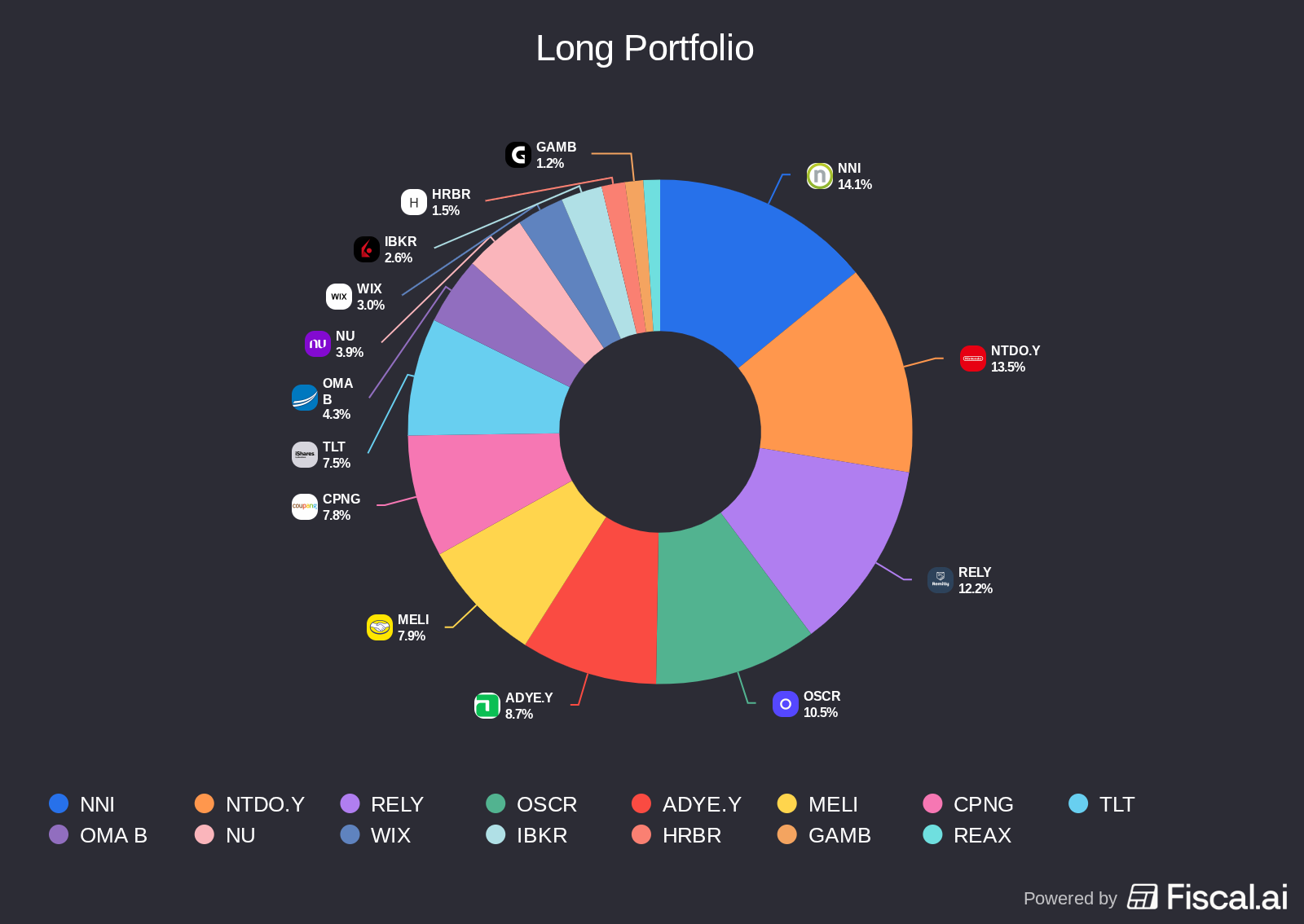
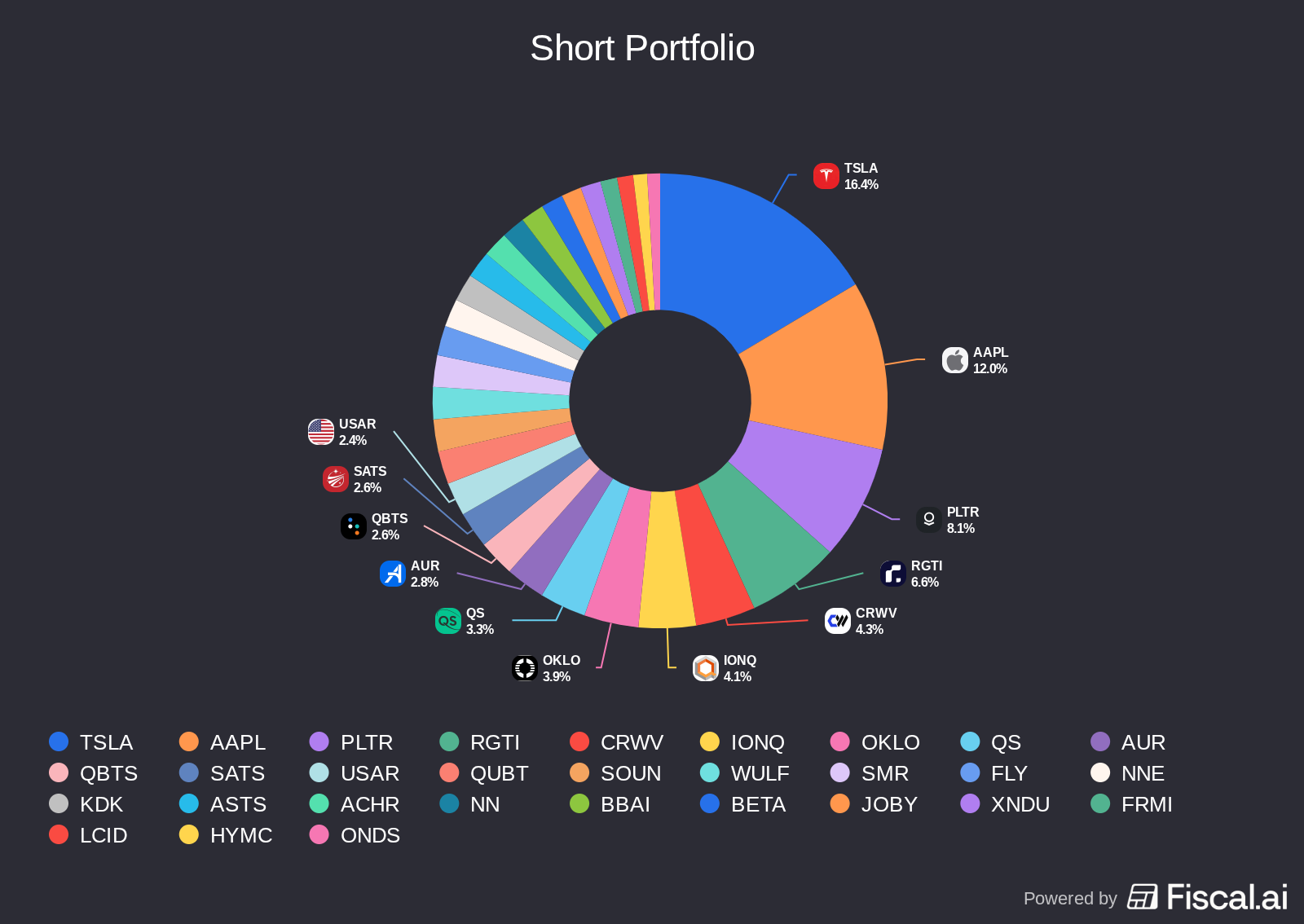
Taxes should never be ignored when making portfolio decisions. I do not intentionally try to lose money, but there will be varying volatility and mistakes each quarter that I can take advantage of with tax-loss harvesting. Think of realized losses as a tank you continuously want to fill to offset any gains taken in the year. As long as I have an equivalent stock I can get long or short with equal conviction, it makes sense to take the one-month opportunity cost risk by exiting the positions if there is a significant capital loss to realize.
Until next time.
-Brett